
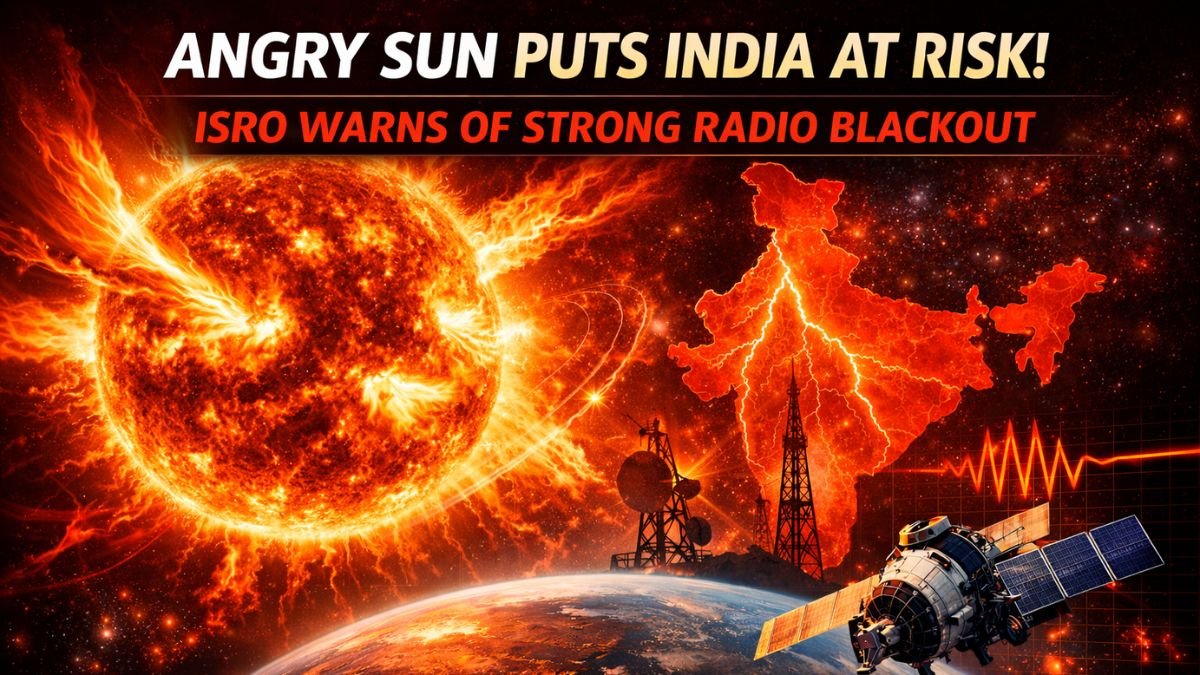
In recent years, the Sun has become increasingly active, drawing the attention of scientists and space agencies around the world. When headlines say “Angry Sun,” they are referring to intense solar activity such as solar flares and coronal mass ejections that can directly affect Earth. According to warnings issued by the Indian Space Research Organisation (ISRO), this heightened solar behavior could put India at risk of strong radio blackouts. While the Sun is the source of life and energy on Earth, its more violent outbursts can disrupt modern technology in ways that affect daily life, national security, and critical infrastructure.
What Does an “Angry Sun” Really Mean?
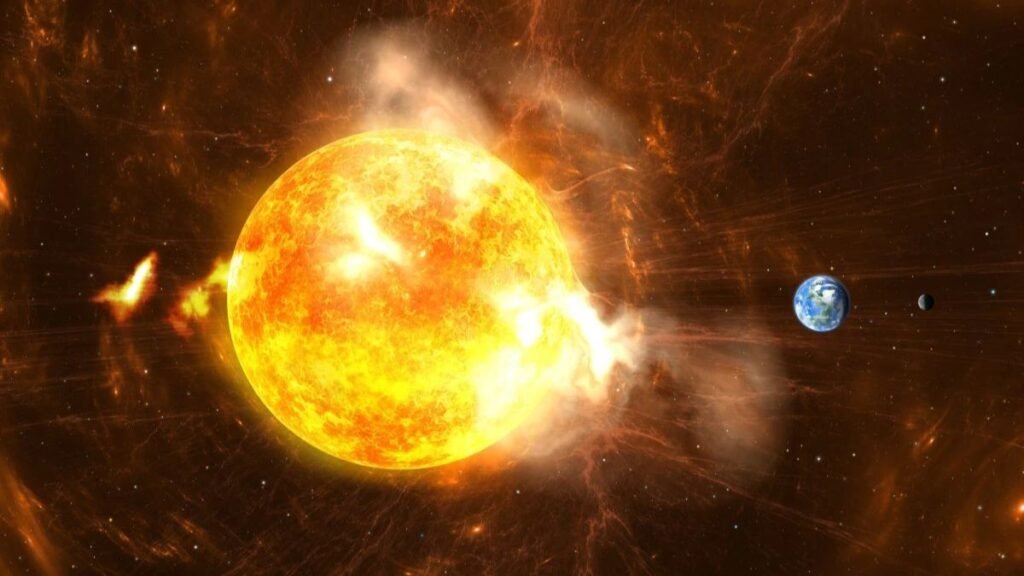
The term “Angry Sun” is not scientific, but it is commonly used to describe periods when the Sun releases unusually powerful bursts of energy. These bursts often take the form of solar flares, which are sudden flashes of radiation, or coronal mass ejections, which involve massive clouds of charged particles being hurled into space. When these events are directed toward Earth, they interact with our planet’s magnetic field and upper atmosphere. This interaction can disturb radio signals, satellite operations, and navigation systems, creating what scientists call space weather effects.
ISRO’s Warning and Why It Matters
ISRO’s warning about a potential strong radio blackout highlights how serious space weather can be for a country like India. With its vast population, growing digital infrastructure, and increasing dependence on satellite-based services, India is particularly vulnerable to disruptions caused by solar activity. ISRO continuously monitors the Sun using space-based and ground-based observations, and when solar activity reaches dangerous levels, early warnings become essential. These alerts allow communication agencies, aviation authorities, and emergency services to prepare for possible disruptions.
How Solar Flares Cause Radio Blackouts
Radio blackouts occur when intense solar radiation ionizes the upper layers of Earth’s atmosphere. During a strong solar flare, X-rays and extreme ultraviolet radiation reach Earth at the speed of light. These waves increase ionization in the ionosphere, especially on the sun-facing side of the planet. As a result, high-frequency radio signals used for communication and navigation are absorbed rather than reflected, leading to sudden and sometimes complete signal loss. For a country as geographically large as India, such disruptions can affect vast regions simultaneously.
Why India Is Particularly at Risk
India’s location and technological landscape make it especially sensitive to solar-induced radio blackouts. Aviation routes over the Indian subcontinent rely heavily on radio communication, particularly for long-distance flights. Maritime operations, defense communications, disaster response systems, and even everyday broadcasting can be affected. Additionally, India’s rapid expansion in satellite technology, including navigation systems and weather monitoring satellites, increases the potential impact of solar storms. ISRO’s warning reflects the reality that space weather is no longer a distant scientific concern but a practical national issue.
The Role of the Sun’s Activity Cycle
The Sun follows an approximately 11-year activity cycle, moving between periods of low and high solar activity. During solar maximum, the number of sunspots, solar flares, and coronal mass ejections increases significantly. Scientists believe that the current phase of the solar cycle is approaching or entering a more active stage, which explains the recent warnings. As the Sun becomes more active, the likelihood of strong space weather events rises, making preparedness more important than ever for countries like India.
Potential Impact on Communication Systems
One of the most immediate effects of a strong radio blackout is the disruption of communication systems. Shortwave radio, used by aircraft, ships, and emergency services, is especially vulnerable. During a severe event, pilots may experience loss of contact with ground control, and maritime operators may struggle to maintain reliable communication. Even modern systems that rely on satellite links can face temporary degradation. ISRO’s warning underscores the need for backup systems and contingency planning to ensure safety and continuity.
Aviation and Navigation Challenges
Aviation is one of the sectors most affected by solar-induced radio blackouts. Aircraft flying at high altitudes, particularly on polar or long-haul routes, depend on high-frequency radio communication. When a strong solar flare occurs, these signals can disappear without warning. Navigation systems that rely on satellite signals may also experience errors or delays. For India, with its busy airspace and growing number of international flights, such disruptions pose both safety and economic challenges.
Satellite Operations Under Threat
Satellites orbiting Earth are directly exposed to solar radiation and charged particles. During intense solar storms, satellites can experience increased drag, electronic interference, and even permanent damage. ISRO operates a wide range of satellites for communication, weather forecasting, navigation, and scientific research. A strong solar event could affect these assets, disrupting services that millions of people rely on daily. This is why continuous monitoring and timely warnings are critical components of space agency operations.
Power Grids and Infrastructure Risks
Although radio blackouts are the most immediate concern, strong solar activity can also affect power grids. Geomagnetic storms induced by solar events can generate electric currents in long transmission lines, potentially damaging transformers and causing outages. While India’s power grid is designed to handle many challenges, extreme space weather events could still pose risks. ISRO’s warning serves as a reminder that space weather can have cascading effects far beyond communication systems.
How ISRO Monitors Solar Activity
ISRO uses a combination of satellite data, ground-based observatories, and international collaboration to track solar activity. Instruments measure solar radiation, magnetic fields, and particle emissions, allowing scientists to assess the intensity and direction of solar events. By analyzing this data, ISRO can issue alerts when conditions suggest a high risk of radio blackouts or other disruptions. These warnings are shared with relevant authorities to help minimize potential damage.
Preparedness and Mitigation Strategies
While it is impossible to prevent solar storms, their impact can be reduced through preparation. Communication networks can switch to alternative frequencies or backup systems during high-risk periods. Aviation authorities can adjust flight routes and schedules, while satellite operators can place spacecraft in safe modes to protect sensitive electronics. ISRO’s warning encourages all stakeholders to take space weather seriously and integrate it into their risk management strategies.
Public Awareness and the Role of Information
Public understanding of space weather is still limited, even though its effects are becoming more visible. Headlines about an “Angry Sun” help capture attention, but they also need to be accompanied by clear explanations. ISRO’s warnings play an important role in educating the public about why solar activity matters. When people understand that radio blackouts and signal disruptions are natural phenomena linked to solar behavior, panic can be avoided and cooperation improved.
Learning From Past Solar Events
History offers several examples of how powerful solar storms can impact Earth. Past events have caused widespread radio blackouts, satellite failures, and power outages in different parts of the world. By studying these incidents, scientists and engineers can better predict future risks and design more resilient systems. ISRO’s current warning reflects lessons learned from both global and regional experiences with space weather.
The Global Nature of Space Weather Threats
Although ISRO’s warning focuses on India, solar storms are global events. When the Sun releases energy toward Earth, multiple countries can experience similar disruptions depending on timing and location. This makes international cooperation essential. Space agencies around the world share data and forecasts to improve accuracy and response. India’s participation in this global network strengthens its ability to prepare for and respond to space weather threats.
Balancing Alarm With Scientific Perspective
The phrase “Angry Sun” can sound alarming, but scientists emphasize the importance of balance. Solar activity is a natural part of the Sun’s life cycle, and not every flare leads to severe consequences. ISRO’s warning is not meant to create fear but to encourage readiness. By understanding the science behind solar activity and its effects, both authorities and the public can respond calmly and effectively.
Looking Ahead: Why Space Weather Will Matter More
As India continues to advance technologically, its exposure to space weather risks will only increase. Greater reliance on satellites, digital communication, and automated systems means that even short disruptions can have significant consequences. ISRO’s warning about a potential strong radio blackout is a glimpse into a future where space weather forecasting becomes as important as traditional weather prediction.
Conclusion: Staying Prepared in the Age of the Angry Sun
The warning that an “Angry Sun” could put India at risk of a strong radio blackout highlights a growing challenge of the modern world. Solar activity, once a topic of interest mainly to scientists, now has direct implications for communication, transportation, and national infrastructure. ISRO’s role in monitoring and warning about these risks is crucial for national preparedness. By staying informed, investing in resilient systems, and respecting the power of the Sun, India can reduce the impact of space weather events and navigate safely through this active phase of the solar cycle.
FAQs
Q1. What does “Angry Sun” mean in this context?
It refers to intense solar activity like solar flares that can disrupt Earth’s communication systems.
Q2. How can a solar event cause a radio blackout in India?
Strong solar radiation ionizes the atmosphere, blocking or absorbing radio signals used for communication.
Q3. Who is affected by a strong radio blackout?
Aviation, maritime services, satellite operations, emergency communications, and broadcasters can all be impacted.
