
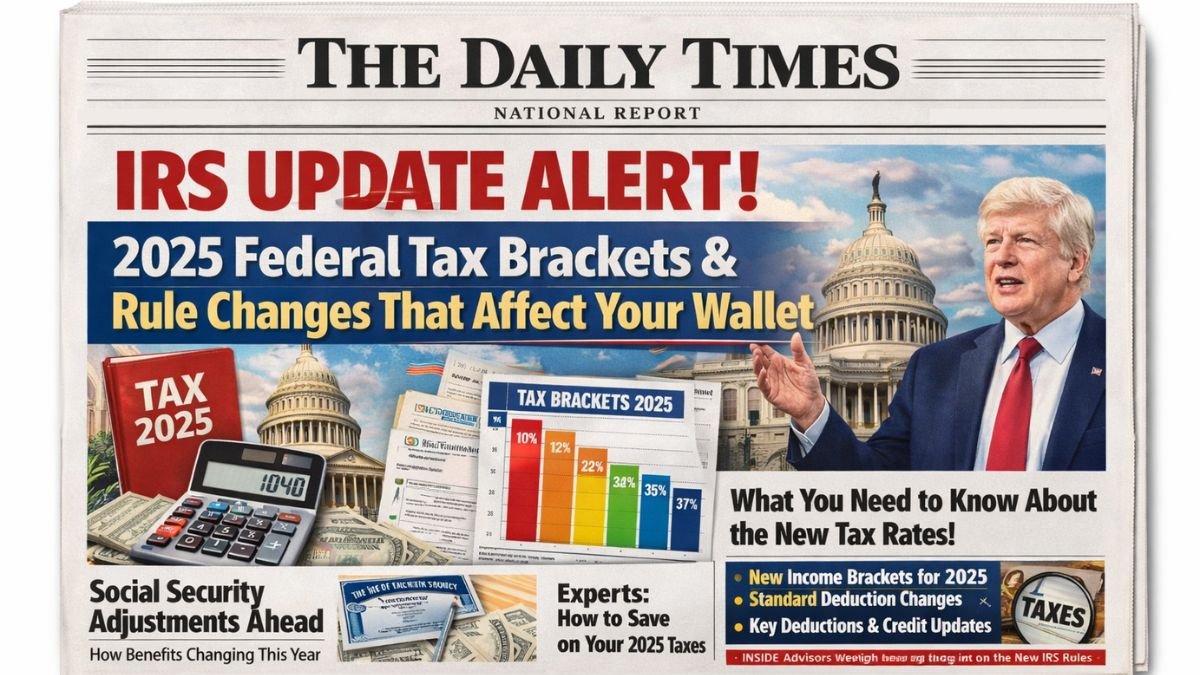
IRS Update Alert! 2026 Federal Tax Brackets: The year 2026 marks a significant turning point in the American tax system. The primary reason for this is the One Big Beautiful Bill Act (OBBB), signed into law by former President Donald Trump on July 4, 2026. This legislation is not merely a simple tax change; it redefines several key aspects of the federal tax system. Its impact will be felt by everyone, from average taxpayers to families, investors, and those planning for retirement.
Although the law took effect in 2026, its real impact will become apparent when people file their 2026 tax returns by April 15, 2026 (Tax Day). This means the upcoming tax season could be a different and new experience for many.
Federal Tax Rules for 2026: What You Need to Know
The tax rules established for calendar year 2026 following the implementation of the OBBB are significantly different from previous years. This article primarily focuses on federal income tax rules. State and local taxes are not included, as they vary by state and are quite extensive.
It’s also important to note that this information does not cover all tax rules. Many specific deductions and credits depend on an individual’s income, family situation, and investments. Therefore, it is advisable to consult the IRS, a tax professional, or reliable tax filing software before making any final decisions.
2026 Federal Income Tax Brackets: How Much Tax Will You Pay?
In 2026, the federal income tax brackets are divided into three main categories. These categories are based on the taxpayer’s filing status.
- The first category is Single Taxpayers, which includes individuals who are unmarried or file separately.
- The second category is Head of Household, which includes taxpayers who support a family and meet certain specific requirements.
- The third and most common category is Married Filing Jointly, which includes married couples who file their tax returns together.
Following the OBBB, the tax brackets for these three categories have been revised to make the tax system simpler and more predictable. Different tax rates apply to different income levels, determining what percentage of your total income goes towards taxes.
2026 Standard Deduction: The Easiest Way to Save on Taxes
The standard deduction is a great help for those who don’t want to itemize their deductions. In 2026, taxpayers will still have two options—either take the Standard Deduction or claim Itemized Deductions by adding up various expenses.
The amount of the standard deduction has been changed after the OBBB, which is expected to directly benefit the middle and lower-income groups. Choosing the right option is crucial, as this decision can significantly reduce your taxable income.
New Rules for Common Tax Deductions in 2026
The OBBB has changed the rules for several common tax deductions. These include deductions for home loan interest, education-related expenses, medical expenses, and certain investments. The aim of these changes is to make the tax system more transparent and reduce the possibility of fraudulent claims.
Some deductions now have stricter limits, while others have been implemented with clearer rules. Therefore, relying on old rules when planning your taxes in 2026 could be a mistake.
Tax Credits 2026: Child Tax Credit and Other Benefits
There is a big difference between deductions and credits. While deductions reduce your taxable income, tax credits directly reduce your tax bill. In 2026, several important changes have been made to tax credits, especially the Child Tax Credit (CTC).
Following the OBBB, the rules for the CTC have been clarified to ensure that eligible families receive the full benefit. In addition, the rules for tax credits related to education, energy-saving, and certain special circumstances have also been updated.
2026 Payroll Tax Rates: How Much Will Be Deducted from Your Salary?
Payroll tax is a tax that is deducted directly from your salary. This includes taxes such as Social Security and Medicare. The payroll tax rates and income thresholds have been updated for 2026.
It’s important to note that this only refers to the taxes paid by the employee. Employers also pay their share of taxes separately, but this is not reflected on your payslip.
Long-Term Capital Gains Tax: What’s Changed for Investors?
For those who invest in the stock market, mutual funds, or real estate, the Long-Term Capital Gains Tax is extremely important. The tax brackets for long-term capital gains have also been revised for 2026.
If you have held an asset for more than a year, the profit earned on it will be considered a long-term capital gain. Profits from assets held for less than a year will be subject to ordinary income tax rates.
Retirement Planning: New Limits and Rules for 2026
Under the OBBB (Omnibus Budget Reconciliation Act), the contribution limits and income limits for retirement accounts such as 401(k), IRA, and other tax-advantaged plans have been updated for 2026. The goal is to provide people with better opportunities for retirement planning.
By understanding these limits and investing accordingly, you can strengthen your future financial security while also saving on taxes.
Tax-Advantaged Savings Accounts: What are the Rules for 529 and HSA?
In 2026, the rules for 529 plans and Health Savings Accounts (HSAs) have also been updated. Changes have also been made to the rules governing Health Savings Accounts (HSAs) and other tax-advantaged savings accounts. Using these accounts correctly can be a smart way to reduce your tax burden.
However, each account has its own rules and regulations, so investing without complete information can be detrimental.
Conclusion: Why is the 2026 Tax Season Special?
The One Big Beautiful Bill Act (OBBB) has completely reshaped the 2026 tax system. Changes will be seen in every area—tax brackets, deductions, credits, payroll taxes, and retirement planning. Therefore, having the right information and proper planning is crucial before filing your 2026 tax return.
If you understand these rules in advance, you can not only save on taxes but also strengthen your future financial security.
FAQs
Q. What is the One Big Beautiful Bill Act (OBBB)?
A. OBBB is a major tax law signed on July 4, 2026, that updates federal tax rules starting in the 2026 tax year.
Q. When will taxpayers feel the impact of OBBB?
A. Taxpayers will see the impact when filing their 2026 tax returns by April 15, 2026.
Q. Does OBBB apply to state and local taxes?
A. No, OBBB only affects federal taxes. State and local tax rules vary by state.
