
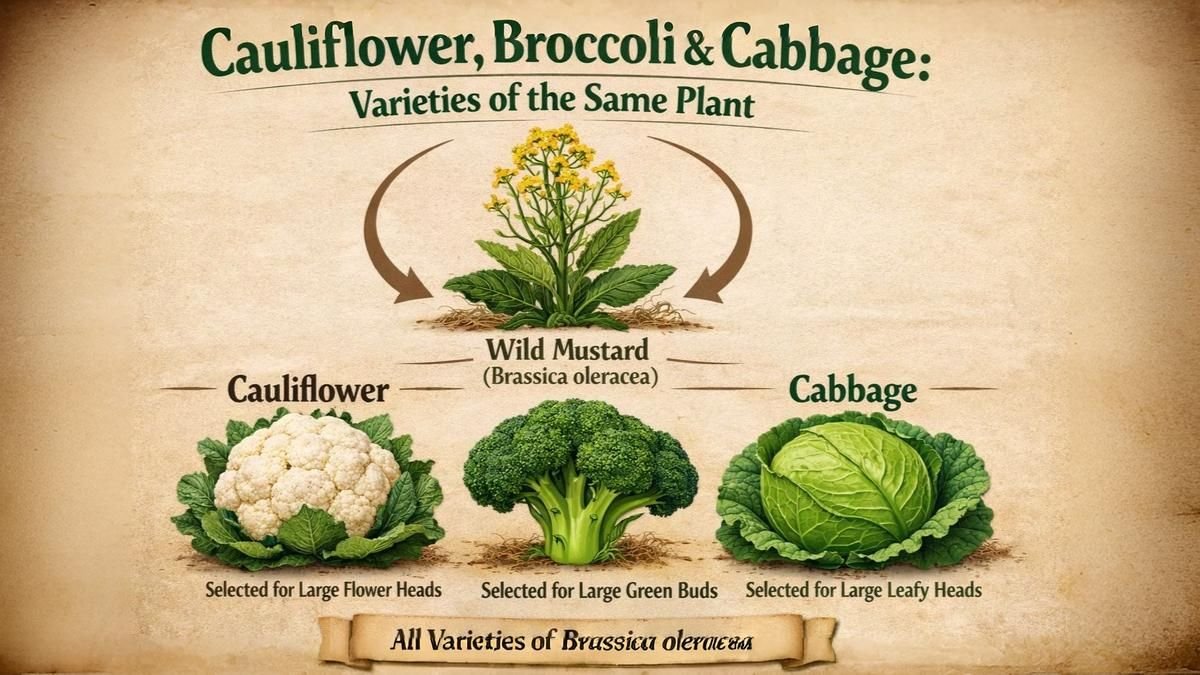
Many people don’t know this, but cauliflower: When we look at cauliflower, broccoli, and cabbage, we usually consider them three completely different vegetables. Each has a different texture, taste, and color. These vegetables are readily available in almost every vegetable market and are used in various cuisines around the world. They are especially popular when it comes to healthy eating. But behind these vegetables lies an interesting and surprising story that very few people know. The truth is that cauliflower, broccoli, and cabbage—all three—evolved from the same original plant. Human ingenuity, patience, and agricultural experience transformed a simple wild plant into the diverse forms that grace our plates today.
Vegetables Born from the Same Mother: The Unique Legacy of Brassica oleracea
The plant at the root of all these vegetables is called Brassica oleracea. It was a wild plant found thousands of years ago in the coastal regions of Western Europe. It wasn’t a particularly attractive plant—simple green leaves, a straightforward structure, and limited uses. But this plant possessed a special quality that immortalized it in history. This plant had the ability to adapt very quickly to human selection and cultivation methods.
Ancient farmers gradually understood that if they selected certain plants and sowed their seeds, the form, taste, and size of the plant could be altered in subsequent generations. This marked the beginning of a long process that we now call artificial selection. Through this process, many different vegetables were born from the same plant.
Cabbage: The Story of the First and Simplest Transformation
Among the vegetables derived from Brassica oleracea, cabbage is considered the earliest form. Farmers began selecting plants with larger, thicker, and juicier leaves. Gradually, these leaves began to grow closer together, forming a round shape, and thus cabbage was born. Over time, several varieties developed in different regions – such as head cabbage, leafy cabbage, and kale.
Cabbage has been a part of people’s diets for centuries. It is an inexpensive, easy-to-grow, and long-lasting vegetable. This is why it became an important part of traditional and rural cuisine. Nutritionally, cabbage is also very beneficial. It’s even more interesting to know that this seemingly simple cabbage later gave rise to special vegetables like cauliflower and broccoli.
Cauliflower: When humans made the flower the center of their meal
The development of cauliflower is even more unique than that of cabbage. Here, farmers began to focus on the flowers of the plant instead of the leaves. In some plants, the flowers became denser, whiter, and larger. These plants were selectively cultivated, and gradually the form of cauliflower that we recognize today emerged.
Cauliflower has a mild taste and a soft texture, which is why it fits into almost every type of dish. Vegetables, parathas, soups, fritters, or healthy recipes – it’s in demand everywhere. It’s amazing to think that the part that was originally a flower has now become the main attraction on our plates. It’s a wonderful example of human ingenuity and harmony with nature.
Broccoli: A modern-day superfood, but with the same ancient roots
Broccoli is considered a “superfood” today. It enjoys immense popularity in the world of health, fitness, and diet. But very few people know that broccoli also belongs to the same Brassica oleracea family. Broccoli developed from plants that produced many small flower branches instead of a single large flower.
These plants were selectively cultivated, and over time, the green, branched form of broccoli that we see today emerged. It has a slightly pungent taste and a crunchy texture, which sets it apart from other vegetables. Whether boiled, roasted, or in a salad, broccoli is enjoyed in every form. It is actually a “close relative” of cauliflower, the only difference being that its florets are divided into separate branches.
The Wisdom of Ancient Farmers: Science Without Science
Today we talk about genetic science and modern technology, but thousands of years ago, farmers achieved this feat without any labs or machines. They carefully observed nature, understood the changes, and made decisions based on that understanding. Brassica oleracea is the perfect example of this.
Each new vegetable was the result of a deliberate thought process – sometimes focusing on enlarging the leaves, sometimes the flowers, and sometimes the stem. In this way, humans created several types of vegetables from a single plant. This biodiversity is a testament to human patience and experience.
Lesser-Known Varieties: When One Plant Yields Even More Surprising Forms
This family includes not only cabbage, cauliflower, and broccoli. Brussels sprouts, kohlrabi, and Romanesco are also derived from the same plant. The geometric structure of Romanesco still amazes people today. It looks like a mathematical design, but in reality, it is also the result of a long process of selective breeding.
Why This Story Matters: The History Behind Our Food
Knowing that our everyday vegetables come from a single plant teaches us to see food not just as nutrition, but as a part of history. It reminds us of the amazing results that humans and nature can achieve together.
In today’s world, where agriculture is rapidly changing, this story helps us understand the importance of traditional farming and biodiversity.
Conclusion: One Plant, Countless Forms, and Humanity’s Enduring Legacy
Cauliflower, broccoli, and cabbage are not just vegetables. They are not just vegetables, but living examples of human ingenuity and cooperation with nature. This journey, which began with a simple wild plant, has now reached our plates. Every time we eat these vegetables, we unknowingly savor the taste of thousands of years of agricultural tradition and human effort. That is the greatest beauty of this story.
FAQs
Q. Are cauliflower, broccoli, and cabbage from the same plant?
A. Yes, all three come from the same plant species called Brassica oleracea.
Q. Why do these vegetables look so different if they are the same species?
A. They look different because humans selectively bred the plant to emphasize different parts like leaves, flowers, or stems.
Q. Which part of the plant is eaten in cauliflower?
A. In cauliflower, the edible part is the undeveloped flower head.
