
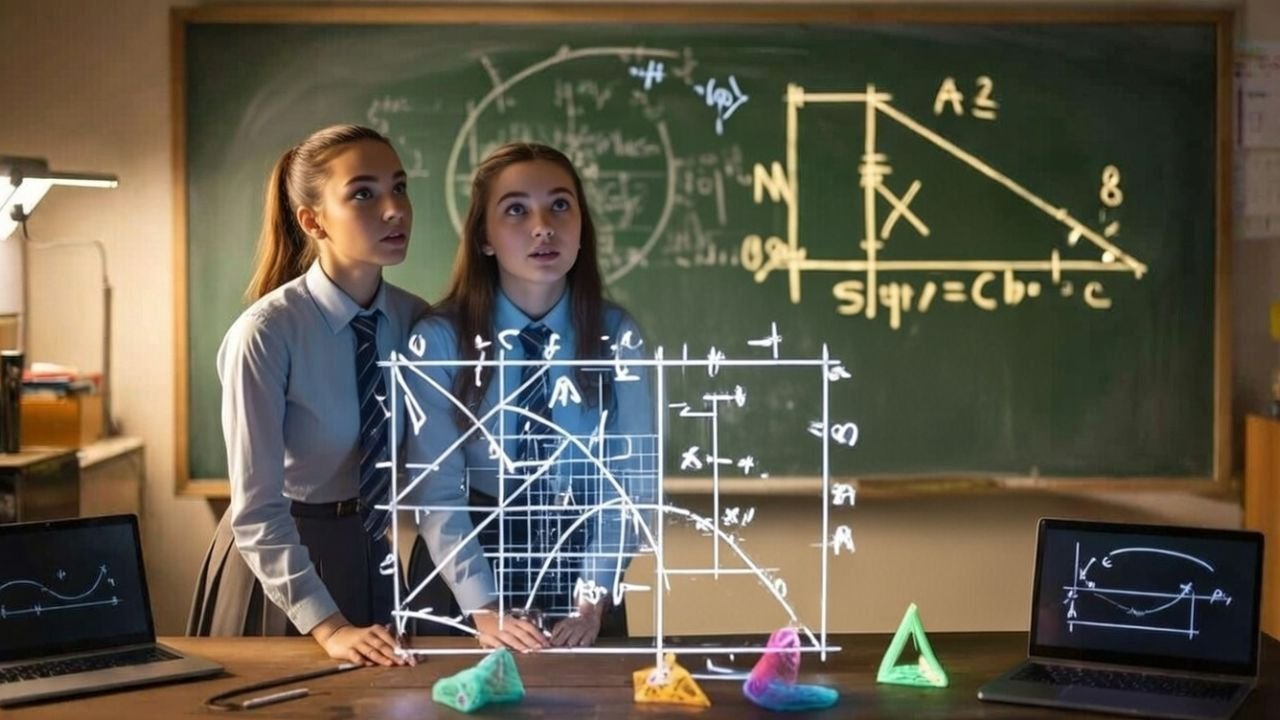
On a stage typically reserved for university professors and researchers presenting their complex theories, two high school students stood and delivered a presentation that forced the mathematics community to reconsider. They didn’t invent a new formula, nor did they disprove the Pythagorean theorem. Instead, they challenged the very path we take to arrive at that famous result. This story isn’t just about a theorem, but about who has the right to advance mathematics—and the answer is: anyone with curiosity.
Two Teenagers, an Ancient Theorem, and a Fundamental Question
For the past two millennia, the Pythagorean theorem has stood as a cornerstone of geometry. In a right triangle, the square of the hypotenuse is equal to the sum of the squares of the other two sides—that is, a² + b² = c². Hundreds of proofs have been offered over the centuries: through dissection of shapes, algebraic manipulation, and various ingenious historical methods.
Yet, one question has always lingered: Can we prove the Pythagorean theorem using trigonometry—without relying on the theorem itself? Because the concepts of sine and cosine are typically defined in terms of right triangles and the hypotenuse, a danger of circular reasoning arises.
This is where Ne’Kia Jackson and Calcea Johnson began their journey.
A Proof That Doesn’t Chase Its Own Tail
These students started with facts that don’t require the Pythagorean theorem:
- The properties of similar triangles
- The relationships between the angles of a triangle
- Ratios and proportions
From these fundamental geometric ideas, they redefined the definitions of sine and cosine. Instead of the traditional “opposite side / hypotenuse” definition, they linked angles and length ratios based on similarity. Gradually, they arrived at the famous identity that every student knows:
sin²(x) + cos²(x) = 1
The crucial point was that they did not rely on the Pythagorean theorem to reach this identity. In other words, this fundamental truth of trigonometry was shown to stand on its own.
Next, they connected these abstract functions to real triangles, relating them to the lengths of the sides, and ultimately arrived at the familiar result:
a² + b² = c²
In this way, they provided a proof of the Pythagorean theorem through trigonometry that did not implicitly assume the theorem itself.
Not One, But Multiple Proofs
Their work wasn’t limited to just one clever argument. They derived several different proofs from their framework. One of these proofs even “generated” other proofs—like a machine producing different shapes.
This kind of diversity is highly valued in mathematics. When a new method yields a whole family of arguments, the community gains confidence in that approach.
| Aspect | Traditional Method | Jackson–Johnson Method |
|---|---|---|
| Starting Point | Right triangle and known theorems | Similarity, angle relationships, ratios |
| Role of Trigonometry | Based on Pythagoras | Independently defined |
| Risk of Circular Reasoning | Higher | Carefully avoided |
| Outcome | Single proof | Multiple, interconnected proofs |
From a Louisiana Classroom to the National Stage
These two students worked on this idea for four years while studying in Louisiana. In 2023, they presented their work at a major mathematics conference in the United States. Since these conferences typically feature experienced researchers, the fact that two teenagers reached this level became news in itself.
Soon after, their research was published in a prestigious mathematics journal. This meant that experts had reviewed every step and found it sound. ## Why This Isn’t Just an Inspirational Story, But Real Math
Nothing will change in daily life. The engineers building bridges will still use a² + b² = c². But the impact at a deeper level is different.
When a new proof is found for an old theorem, it often brings new tools with it. Here, the foundations of trigonometry are connected to even more fundamental geometric ideas. This approach could prove useful in:
- The mathematics of angles and distances in computer graphics
- Calculations of motion and direction in robotics
- Numerical methods
Small theoretical changes sometimes yield significant computational advantages.
A Message for Students Who Don’t Consider Themselves “Math People”
Interestingly, neither of the students went into pure mathematics — one is studying environmental engineering, the other pharmacy. Yet they contributed to mathematical theory.
This sends a clear message: innovative thinking in mathematics is not solely the domain of professional mathematicians. Curiosity, patience, and hard work are equally important factors.
A New Way to Teach in the Classroom
This story is also useful for educators. Instead of simply presenting sine and cosine as formulas, they can start with similar triangles. Students can draw different triangles and measure the side ratios for the same angle — and see that the ratio remains constant. This makes trigonometry seem less like “magic” and more like a natural extension of geometry.
What Else Could Change?
This work reminds us that the idea that “everything in mathematics is already settled” is incomplete. Often, new knowledge True understanding doesn’t come from a new result, but from a new way of arriving at an old result.
The biggest lesson is this: even if a formula seems unassailable, the path to its foundation may still be open to new ideas. And sometimes, that path can be discovered by two curious teenagers.
FAQs
1. Did the students change the Pythagorean theorem?
No. The formula a² + b² = c² remains exactly the same. They introduced a new way to prove it, not a new result.
2. What was special about their proof?
They used trigonometry to prove the theorem without secretly relying on the theorem itself, avoiding circular reasoning.
3. Why is circular reasoning a problem here?
Because many trigonometric definitions already assume the Pythagorean theorem, which would make the proof logically invalid.
4. Who are the students behind this work?
Ne’Kiya Jackson and Calcea Johnson, two former high-school students from Louisiana.
5. Does this discovery change practical math applications?
Not directly, but it offers new theoretical insights that could influence how math is taught and understood in the future.
