
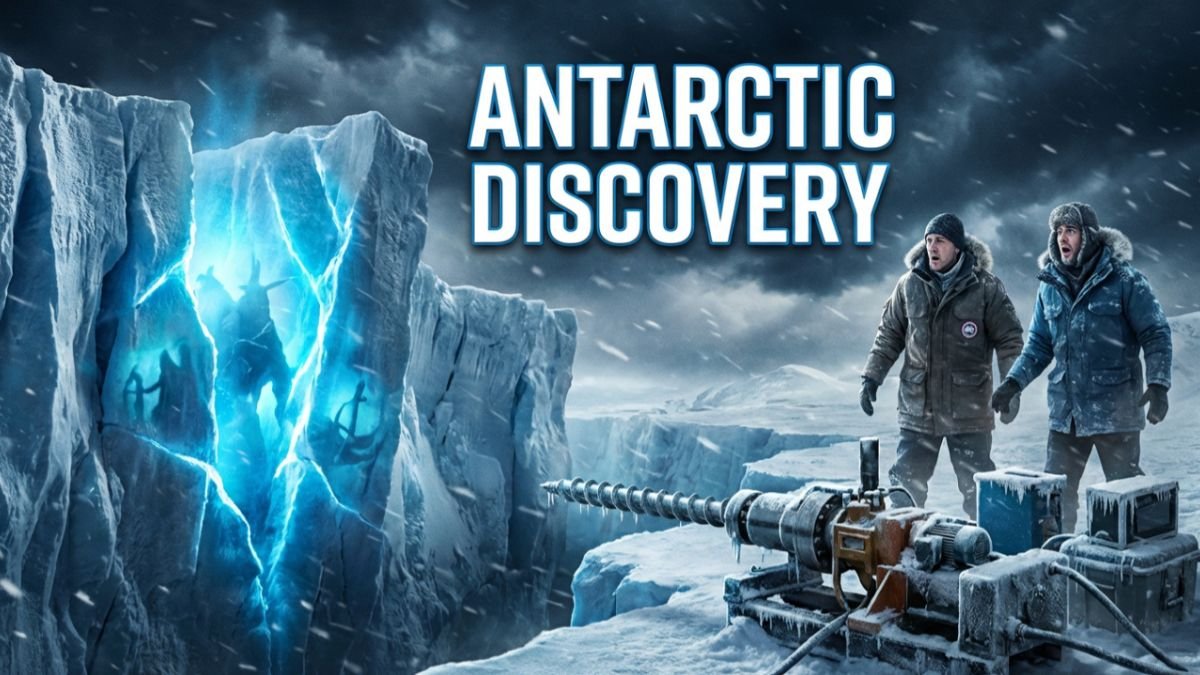
For decades, Antarctic ice has been known as the coldest, most desolate place on Earth—a frozen continent where life struggles to survive, and the land remains locked beneath towering sheets of ice. Yet, what scientists recently uncovered deep beneath this icy wilderness has stunned the world. Almost two kilometers below the surface, researchers have found traces of a lost world that existed nearly 34 million years ago, a time when Antarctica was not the icy desert it is today but a thriving ecosystem filled with plants, rivers, forests, and vibrant forms of life. This extraordinary discovery is not just a scientific milestone; it is a glimpse into Earth’s ancient past, revealing how dramatically the planet can transform over millions of years.
A Window Into an Ancient, Forgotten Earth
To imagine Antarctica as anything other than a frozen continent is difficult for most people. But the evidence uncovered by scientists paints a completely different picture. Millions of years ago, Antarctica was warm and lush, with temperatures similar to modern-day parts of New Zealand. The newly discovered ancient landscape now buried beneath ice represents a period when the continent was part of a thriving green world filled with dense vegetation, flowing rivers, and rich biodiversity. What makes this discovery so fascinating is that it provides a rare window into a time before the massive ice sheets formed, helping scientists understand how climate shapes continents and ecosystems.
How Scientists Found the Lost World
Uncovering a landscape preserved under two kilometers of ice is no simple task. The discovery emerged from a series of deep-ice drilling expeditions designed to understand Antarctica’s geological history. Using highly advanced drilling equipment, researchers extracted core samples from the ice sheet. What they found inside these cores shocked them. Instead of only frozen water or compacted snow from ancient climates, they discovered layers of sediment, fossilized plant material, and traces of soil that had been untouched for tens of millions of years. These remains acted as time capsules, preserving the story of an ancient world lying silently beneath the massive ice sheet.
The scientists used technologies such as radar imaging, sediment analysis, and microfossil examination to rebuild the picture of the landscape hidden below. Each discovery added another layer of understanding, revealing valleys, river channels, and soils rich with organic material, all of which pointed to a once-living environment now sealed in ice.
An Antarctica That Was Once Alive
Perhaps the most captivating aspect of this finding is the realization that Antarctica once looked nothing like the frozen wasteland we know today. Sediment samples showed pollen grains, spores, and microscopic plant fragments that indicate the presence of lush vegetation. Such evidence suggests that parts of Antarctica were covered with temperate forests, similar to those found in regions far from today’s polar environment.
Scientists believe that this ancient world included tall trees, thick undergrowth, flowing rivers, and diverse ecosystems. During that era, Antarctica was still attached to other landmasses, forming part of the supercontinent Gondwana, which helped it maintain a much warmer climate. The atmosphere was rich in greenhouse gases, and the planet was experiencing a warm phase that allowed forests to flourish even in what is now the coldest place on Earth.
The Moment the Ice Began to Take Over
The transition from a warm, vibrant continent to the frozen world we see today was dramatic. About 34 million years ago, Earth entered a major cooling phase known as the Eocene–Oligocene transition. This period marked the beginning of Antarctica’s deep freeze. As temperatures dropped worldwide, ice sheets began to form and quickly expanded across the continent. The warm forests could not survive the rapid change. Over time, the rivers froze, vegetation died out, and massive ice sheets spread over the land, trapping the ancient world beneath them and preserving it in near-perfect condition.
This sudden freeze transformed Antarctica from a fertile, green environment into the isolated, icy desert that has remained frozen for millions of years. The buried landscape is a physical reminder of how rapidly and dramatically the planet’s climate can shift.
Why This Discovery Matters Today
Although the discovery is rooted in the distant past, it has urgent implications for our present and future. Understanding how Antarctica transformed from a warm, forested continent to an icy one helps scientists understand the complex relationship between climate and geography. This knowledge becomes crucial as the world currently faces another major shift in climate.
By studying the sediments and fossils found beneath the ice, scientists can determine how fast environmental changes occurred and how ecosystems responded. These clues help researchers predict how Earth’s climate may evolve and how modern ice sheets, particularly in Antarctica, might react to ongoing global warming. The ancient world preserved in ice is a warning from the past—an example of how ecosystems can collapse when climate conditions change too quickly.
A Message Hidden Beneath Ice and Time
Every discovery underneath Antarctica tells a story not only of the past but also of what lies ahead. The lost world beneath the ice demonstrates that Earth is continuously evolving. It shows that today’s landscapes will not always look the same millions of years from now. What makes this finding so profound is its silent message: no matter how stable a place may seem, nature can transform it beyond recognition.
The frozen remains of forests, soil, and ancient waterways remind us that even the coldest places on Earth were once warm and full of life. They also show that Earth’s climate is a delicate system that can shift rapidly. The discovery encourages us to view climate not as a fixed condition but as an ever-changing force that can redefine continents and reshape entire ecosystems.
The Technological Triumph Behind the Discovery
Drilling through two kilometers of solid ice requires extraordinary engineering. Scientists employed hot-water drilling systems, advanced ice-core retrieval machines, and specialized equipment capable of preserving fragile samples. Each piece of technology had to work with precision because the frozen landscape had to be removed carefully to avoid destroying the ancient material trapped inside the core.
Once the cores were extracted, teams of researchers from multiple scientific fields worked together. Geologists analyzed the minerals and soil layers, paleobotanists studied plant remnants, and climate scientists examined the trapped air bubbles that preserved ancient atmospheric conditions. The multidisciplinary effort allowed scientists to reconstruct the ancient world with remarkable detail, turning tiny fragments of soil and fossil into a vast, vivid picture of Earth’s long-forgotten environment.
A Landscape Frozen in Perfect Preservation
One of the most astonishing aspects of the discovery is the level of preservation. The ice acted as a natural vault, sealing away the landscape for millions of years without exposing it to erosion or decay. The buried world remained untouched, locked beneath immense pressure and extreme cold.
Because of this preservation, scientists were able to study soil that still contained organic material from plants that lived over 30 million years ago. It is rare in geology to find landscapes so perfectly sealed from the passage of time. The ice sheets essentially froze a moment in Earth’s history, allowing researchers to uncover evidence that would have otherwise been lost forever.
What This Means for the Future of Exploration
The discovery beneath Antarctica is likely only the beginning. Scientists believe there may be many more ancient landscapes hidden under the ice. Each one could reveal more secrets about Earth’s past climates and ancient ecosystems. As technology improves, deeper drilling and advanced imaging will allow researchers to explore even farther beneath the ice sheets.
This breakthrough encourages further scientific missions, pushing humanity to keep searching beneath the Earth’s most extreme regions. It demonstrates that even the most inaccessible places still hold mysteries waiting to be uncovered.
Conclusion
The revelation of a lost world buried under two kilometers of Antarctic ice is one of the most extraordinary scientific discoveries of our time. It transports us back 34 million years to an era when Antarctica was lush, green, and full of life. The continent’s dramatic transformation into a frozen wilderness reminds us of the immense power of climate change throughout Earth’s history. This ancient world, preserved in ice like a time capsule, offers crucial insights into how our planet evolves and how quickly its environments can shift.
As we uncover more of Antarctica’s hidden past, we gain not only scientific knowledge but also a deeper awareness of Earth’s fragile climatic balance. The lost world beneath the ice stands as both a window into history and a warning for the future, urging us to understand and protect the planet we call home.
FAQs
1. What did scientists discover under Antarctic ice?
A. They found a lost world—an ancient ecosystem buried 34 million years ago beneath 2 km of ice.
2. How old is this lost world?
A. It is estimated to be around 34 million years old, dating back to Earth’s ancient climate era.
3. How deep was the discovery?
A. The hidden world was uncovered 2 kilometers below the Antarctic ice sheet.
